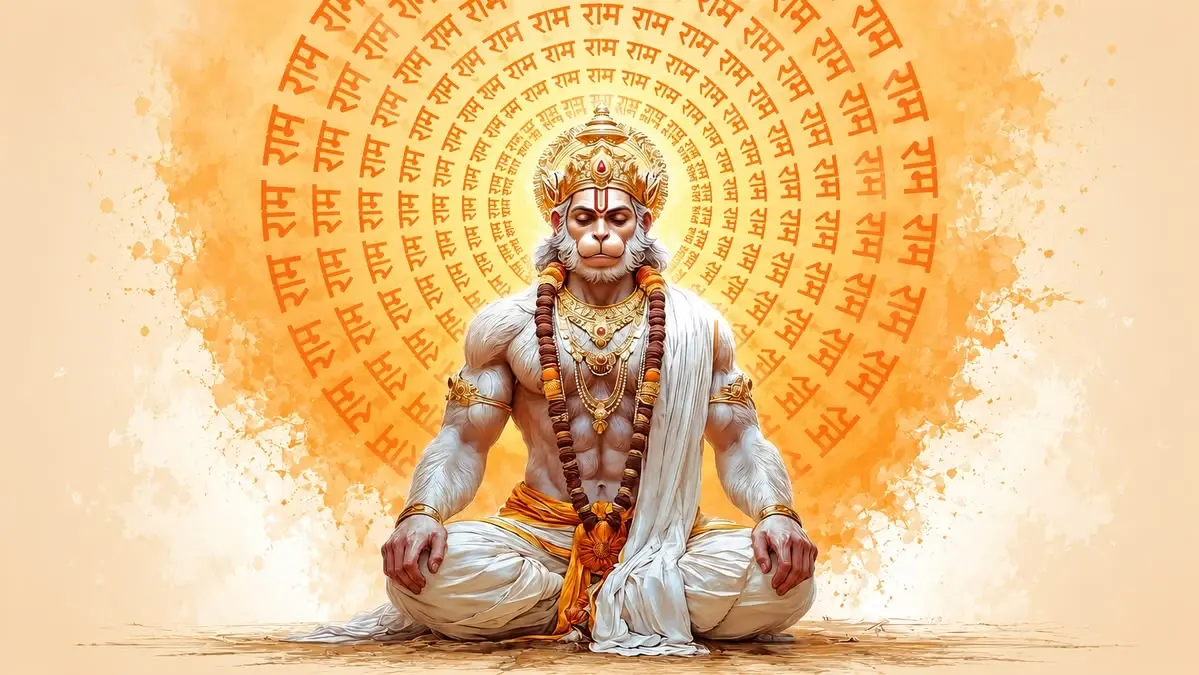
I feel connected to Hanuman.
Your journey with Hanuman हनुमान
Hanuman is strength joined with humility, wisdom joined with service. Many people’s first prayer is the Hanuman Chalisa.
Preview — under editorial review. This entry was prepared with research assistance and its citations have been identified, but it has not yet been checked by a human editor. Please verify against the cited sources before relying on it.
Step 1
Who is Hanuman?
Son of Anjana and Kesari, blessed by Vayu the Wind God. In the Ramayana he finds Sita in Lanka, brings the healing herb for Lakshmana, and serves Rama with complete devotion.
Step 2
What do the scriptures say?
- Valmiki Ramayana — Kishkindha Kanda (his meeting with Rama; his childhood in sarga 66) and the Sundara Kanda, devoted to his journey.
- Mahabharata, Aranyaka Parva — Hanuman meets his brother Bhima.
- Hanuman Chalisa — a 16th-century Awadhi hymn attributed to Tulsidas.
Step 3
Philosophical significance
Hanuman embodies dasya bhakti — devotion as loving service. He shows that great strength is best used in service of others, and that humility is the companion of real power.
How a beginner can start
- 1
Learn the Hanuman Chalisa with its meaning, a few verses at a time.
- 2
Read the Sundara Kanda.
- 3
Do one act of selfless service each week.
Related mantras, stories and scriptures
Mantras and their meanings
श्रीगुरु चरन सरोज रज निज मनु मुकुरु सुधारि।
Hanuman Chalisa (opening)
Cleansing the mirror of my mind with the dust of my guru’s lotus feet, I sing the pure glory of Rama, which grants the four goals of life. Knowing myself to be without wisdom, I remember the son of the Wind — grant me strength, intelligence and learning, and remove my afflictions and faults. Victory to Hanuman, ocean of wisdom and virtue; victory to the lord of the vanaras, illuminator of the three worlds.
श्री राम जय राम जय जय राम
Shri Ram Jai Ram Jai Jai Ram
Revered Rama — glory to Rama, glory, glory to Rama.
Stories from the scriptures
Scriptures that discuss this
Sources & verification
Sources identified · awaiting editorial reviewCitations have been located. A human editor has not yet checked this text against the cited editions.
Valmiki Ramayana — Kishkindha Kanda 66; Sundara Kanda
Established referencePrimary source
Interpretation note
This page describes how this form of the Divine is understood across traditions. It does not ask you to choose this path over another.
Last updated 26 November 2026 · not yet reviewed by a human editor · Our research standards
Explore another path
Understanding other traditions often deepens your own.