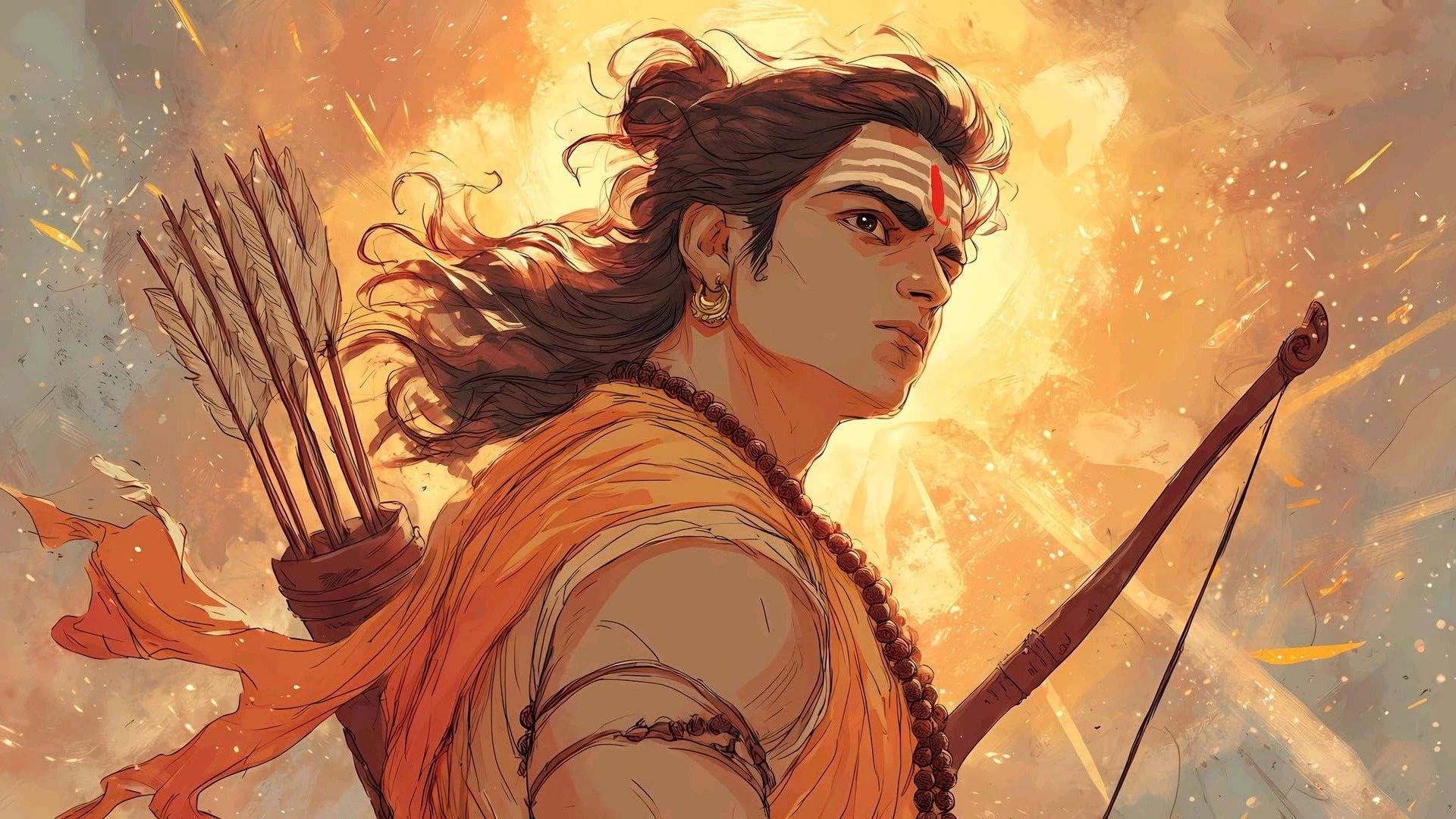
I feel connected to Rama.
Your journey with Rama राम
Rama is remembered as Maryada Purushottama — the one who lived dharma perfectly in every relationship. For millions, simply saying “Ram” is prayer.
Preview — under editorial review. This entry was prepared with research assistance and its citations have been identified, but it has not yet been checked by a human editor. Please verify against the cited sources before relying on it.
Step 1
Who is Rama?
Prince of Ayodhya, son of Dasharatha and Kausalya, husband of Sita. He accepted fourteen years of exile to keep his father’s word, rescued Sita from Ravana with the help of Hanuman and the vanaras, and ruled with justice.
Step 2
What do the scriptures say?
- Valmiki Ramayana — the original Sanskrit epic in seven kandas.
- Bhagavata Purana, Canto 9 — a summary of Rama’s life as an avatara of Vishnu.
- Adhyatma Ramayana — presents Rama as Brahman, in an Advaita light.
- Ramcharitmanas of Tulsidas (16th c., Awadhi) — the most-recited Rama text in North India.
Step 3
Philosophical significance
Rama shows that spirituality is lived in ordinary duties — as a son, brother, husband, friend and ruler. Devotional traditions also teach the power of Rama-nama, the divine name, as a complete path.
Step 4
A note on versions
Many details people know — for example, the Lakshmana Rekha — are absent from Valmiki and come from later retellings. Each Ramayana is meaningful in its own tradition; this site always tells you which one a story comes from.
How a beginner can start
- 1
Read an abridged Valmiki Ramayana, then the Sundara Kanda in full.
- 2
Chant Shri Ram Jai Ram Jai Jai Ram for a few minutes daily.
- 3
Reflect on one quality of Rama each week — truthfulness, patience, loyalty.
Related mantras, stories and scriptures
Mantras and their meanings
श्री राम जय राम जय जय राम
Shri Ram Jai Ram Jai Jai Ram
Revered Rama — glory to Rama, glory, glory to Rama.
हरे राम हरे राम राम राम हरे हरे।
Hare Krishna Mahamantra
A calling out of the divine names Hari, Rama and Krishna.
Stories from the scriptures
Scriptures that discuss this
Sources & verification
Sources identified · awaiting editorial reviewCitations have been located. A human editor has not yet checked this text against the cited editions.
Established referencePrimary source
Interpretation note
This page describes how this form of the Divine is understood across traditions. It does not ask you to choose this path over another.
Still under research
- Confirm statement that Lakshmana Rekha is absent from the Critical Edition of Valmiki.
Last updated 26 November 2026 · not yet reviewed by a human editor · Our research standards
Explore another path
Understanding other traditions often deepens your own.