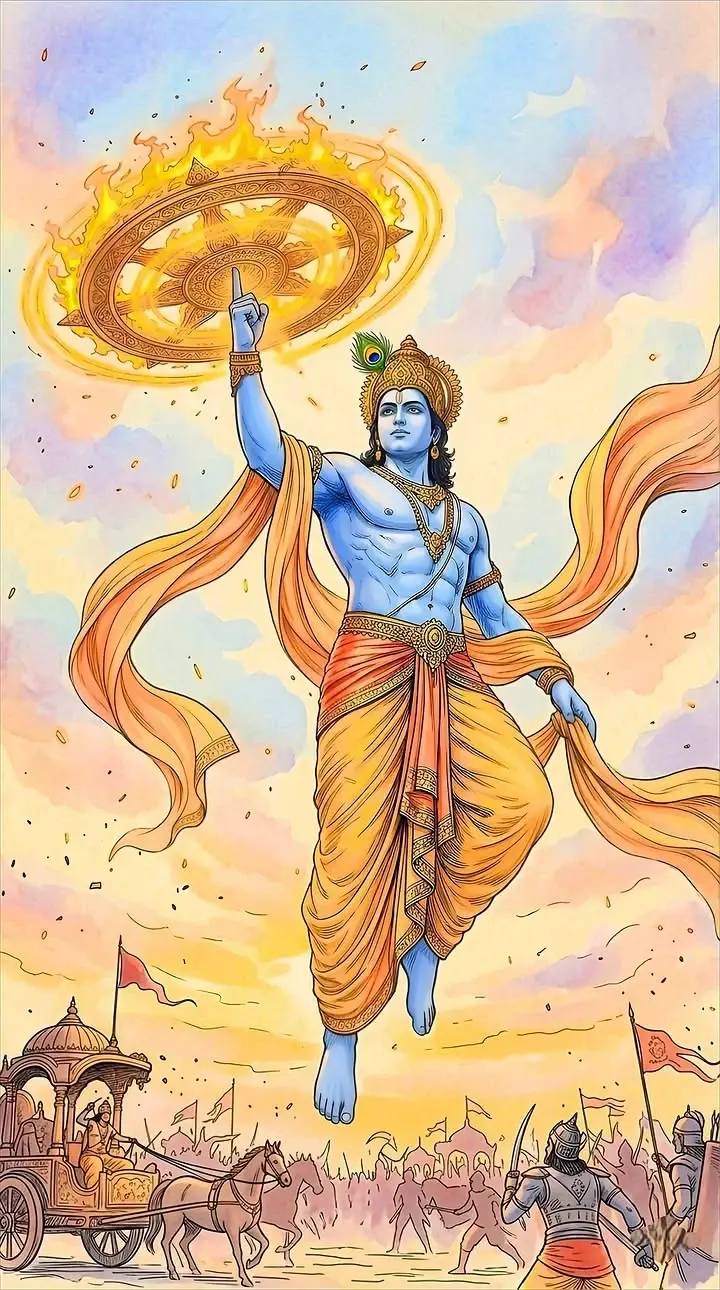
I feel connected to Krishna.
Your journey with Krishna कृष्ण
Krishna is loved as the mischievous child of Vrindavan, the flute-player, the wise friend of Arjuna and the teacher of the Bhagavad Gita. If you feel drawn to him, you are in very large company.
Preview — under editorial review. This entry was prepared with research assistance and its citations have been identified, but it has not yet been checked by a human editor. Please verify against the cited sources before relying on it.
Step 1
Who is Krishna?
Born in Mathura and raised by Yashoda and Nanda in Gokula and Vrindavan, Krishna later became the prince of Dwarka, the friend and counsellor of the Pandavas, and the speaker of the Bhagavad Gita on the battlefield of Kurukshetra.
Step 2
What do the scriptures say?
- Bhagavad Gita — Krishna’s teaching on action, devotion, knowledge and the Self; he reveals his universal form (chapter 11).
- Bhagavata Purana — Canto 10 tells his life; 1.3.28 declares kṛṣṇas tu bhagavān svayam, “Krishna is the Lord himself”.
- Mahabharata and its appendix the Harivamsha.
- Vishnu Purana, Book 5.
Step 3
Philosophical significance
In the Gita Krishna teaches that the Self is eternal (2.20), that we should act without attachment to results (2.47), and that loving devotion is the most intimate path (9.26, 18.65). He also says: “As people approach me, so do I receive them” (4.11) — a verse often read as honouring many paths.
Step 4
How do traditions understand Krishna?
Gaudiya Vaishnavas, Pushti Marg and the Nimbarka tradition see Krishna as the supreme, original form of God. Sri Vaishnavas and Madhvas see him as a full avatara of Vishnu–Narayana. Advaita reads Krishna in the Gita as Ishvara — Brahman with form — guiding the seeker to the Self.
How a beginner can start
- 1
Read the Bhagavad Gita, one chapter a week, in a translation that shows the Sanskrit.
- 2
Compare one chapter in two translations from different traditions on the Gita Supersite.
- 3
Chant a Krishna mantra on a mala, or simply sing his names with family.
- 4
Read the story of Krishna and his poor friend (Bhagavata 10.80–81).
Related mantras, stories and scriptures
Mantras and their meanings
हरे राम हरे राम राम राम हरे हरे।
Hare Krishna Mahamantra
A calling out of the divine names Hari, Rama and Krishna.
ॐ नमो भगवते वासुदेवाय
Om Namo Bhagavate Vasudevaya (Dvadashakshara)
Om, salutations to the Lord Vasudeva, who dwells in all beings.
Stories from the scriptures
Krishna and His Poor Friend
Bhagavata Purana Canto 10, chapters 80–81
Ages 3-5Gajendra, the Elephant Who Called for Help
Bhagavata Purana Canto 8, chapters 2–4
Ages 6-8Prahlada and Lord Narasimha
Bhagavata Purana Canto 7, chapters 1–10
Ages 6-8Dhruva, the Boy Who Became the Pole Star
Bhagavata Purana Canto 4, chapters 8–12
Scriptures that discuss this
Sources & verification
Sources identified · awaiting editorial reviewCitations have been located. A human editor has not yet checked this text against the cited editions.
Bhagavata Purana — 1.3.28
Established referencePrimary source
Bhagavad Gita — 2.20; 2.47; 4.11; 9.26
Established referencePrimary source
Interpretation note
This page describes how this form of the Divine is understood across traditions. It does not ask you to choose this path over another.
Last updated 26 November 2026 · not yet reviewed by a human editor · Our research standards
Explore another path
Understanding other traditions often deepens your own.